Traits
Class options
The Halfling people
Life as a halfling
Halfling gods and myths
The Halfling adventurer
Halfling
The comfort of home are the goal of most halflings’ lives: a place to settle in peace and quiet, far from marauding monsters and clashing armies; a blazing fire and a generous meal; fine drink and fine conversation. Though some halflings live out their days in remote agricultural communities, others form nomadic bands that travel constantly, lured by the open road and the wide horizon to discover the wonders of new lands and peoples. But even these wanderers love peace, food, hearth, and home, though home might be a wagon jostling along an dirt road or a raft floating downriver.
“Regis the halfling, the only one of his kind for hundreds of miles in any direction, locked his fingers behind his head and leaned back against the mossy blanket of the tree trunk. Regis was short, even by the standards of his diminutive race, with the fluff of his curly brown locks barely cresting the three-foot mark, but his belly was amply thickened by his love of a good meal, or several, as the opportunities presented themselves. The crooked stick that served as his fishing pole rose up above him, clenched between two of his toes, and hung out over the quiet lake, mirrored perfectly in the glassy surface of Maer Dualdon.”
– R.A. Salvatore, The Crystal Shard

Small and Practical
The diminutive halflings survive in a world full of larger creatures by avoiding notice or, barring that, avoiding offense. Standing about 3 feet tall, they appear relatively harmless and so have managed to survive for centuries in the shadow of empires and on the edges of wars and political strife. They are inclined to be stout, weighing between 40 and 45 pounds.
Halflings’ skin ranges from tan to pale with a ruddy cast, and their hair is usually brown or sandy brown and wavy. They have brown or hazel eyes. Halfling men often sport long sideburns, but beards are rare among them and mustaches even more so. They like to wear simple, comfortable, and practical clothes, favoring bright colors.
Halfling practicality extends beyond their clothing. They’re concerned with basic needs and simple pleasures and have little use for ostentation. Even the wealthiest of halflings keep their treasures locked in a cellar rather than on display for all to see. They have a knack for finding the most straightforward solution to a problem, and have little patience for dithering.
Kind and Curious
Halflings are an affable and cheerful people. They cherish the bonds of family and friendship as well as the comforts of hearth and home, harboring few dreams of gold or glory.
They love discovering new things, even simple things, such as an exotic food or an unfamiliar style of clothing. Halflings are easily moved to pity and hate to see any living thing suffer. They are generous, happily sharing what they have even in lean times.
Blend in to the Crowd
Halflings are adept at fitting into a community of humans, dwarves, or elves, making themselves valuable and welcome. The combination of their inherent stealth and their unassuming nature helps halflings to avoid unwanted attention.
Halflings work readily with others, and they are loyal to their friends, whether halfling or otherwise. They can display remarkable ferocity when their friends, families, or communities are threatened.
Pastoral Pleasantries
Most halflings live in small, peaceful communities with large farms and well-kept groves. They rarely build kingdoms of their own or even hold much land beyond their quiet shires. They typically don’t recognize any sort of halfling nobility or royalty, instead looking to family elders to guide them. Families preserve their traditional ways despite the rise and fall of empires.
Many halflings live among other races, where the halflings’ hard work and loyal outlook offer them abundant rewards and creature comforts. Some halfling communities travel as a way of life, driving wagons or guiding boats from place to place and maintaining no permanent home.
Exploring Opportunities
Halflings usually set out on the adventurer’s path to defend their communities, support their friends, or explore a wide and wonder-filled world. For them, adventuring is less a career than an opportunity or sometimes a necessity.
Halfling Names
A halfling has a given name, a family name, and possibly a nickname. Family names are often nicknames that stuck so tenaciously they have been passed down through the generations.
-
Male Names: Alton, Ander, Cade, Corrin, Eldon, Errich, Finnan, Garret, Lindal, Lyle, Merric, Milo, Osborn, Perrin, Reed, Roscoe, Wellby
-
Female Names: Andry, Bree, Callie, Cora, Euphemia, Jillian, Kithri, Lavinia, Lidda, Merla, Nedda, Paela, Portia, Seraphina, Shaena, Trym, Vani, Verna
-
Family Names: Brushgather, Goodbarrel, Greenbottle, Highhill, Hilltopple, Leagallow, Tealeaf, Thorngage, Tosscobble, Underbough
Halfling traits
Your halfling character has a number of traits in common with all other halflings.
-
Ability Score Increase. Your Luck ability score, both current and maximum, increases by 4, while your Strength ability score, both current and maximum, is reduced by 4.
-
Age. A halfling reaches adulthood at the age of 20 and generally lives into the middle of its second century.
-
Alignment. Most halflings are lawful good. As a rule, they are good-hearted and kind, hate to see others in pain, and have no tolerance for oppression. They are also very orderly and traditional, leaning heavily on the support of their community and the comfort of their old ways.
-
Languages. You know Common and Halfling. The halfling language isn’t secret, but halflings are loath to share it with others. They write very little, so they don’t have a rich body of literature. Their oral tradition, however, is very strong.
-
Size. Halflings average about 3 ft tall and weigh about 40 pounds. Your size is Small.
-
Speed. Your base speed is 25 ft.
-
Brave. You have advantage on saving throws against being frightened.
-
Halfling Nimbleness. You can move through the space of any creature that is of a size larger than yours.
-
Lucky. When you roll a 1 on an attack roll, ability check, or saving throw, you can reroll the die and must use the new roll.
-
Naturally Stealthy. You can attempt to hide even when you are obscured only by a creature that is at least one size larger than you.
Affable and Positive
Halflings try to get along with everyone else and are loath to make sweeping generalizations – especially negative ones.
-
Dwarves. “Dwarves make loyal friends, and you can count on them to keep their word. But would it hurt them to smile once in a while?”
-
Elves. “They’re so beautiful! Their faces, their music, their grace and all. It’s like they stepped out of a wonderful dream. But there’s no telling what’s going on behind their smiling faces— surely more than they ever let on.”
-
Humans. “Humans are a lot like us, really. At least some of them are. Step out of the castles and keeps, go talk to the farmers and herders and you’ll find good, solid folk. Not that there’s anything wrong with the barons and soldiers—you have to admire their conviction. And by protecting their own lands, they protect us as well.”
Halfling Class Options
A halfling approaches some classes is a bit different than other races. When you select one of these classes, it is modified as follows:
-
Alchemist
Most halflings enjoy helping people and they do enjoy fireworks. If you belong to the Apothecary, or Mad bomber field of study, then whenever the Alchemist class description mentions your Intelligence modifier, you may instead use your proficiency bonus.
-
Barbarian
Halflings are not really built for this class. They neither have the physique, nor the anger that makes for a fearsome barbarian.
-
Bard
For a halfling, entertainment is very important. It is a very big part of their culture, and all types are equally appreciated, from singing to finger puppets.
Whenever the Bard class description mentions your Charisma modifier, you may instead use your proficiency bonus.
-
Cavalier
Halflings are gentle and get along with all kinds of animals. Their militias are known to use riding dogs to form a sort of cavalry.
Whenever the Cavalier class description mentions your Strength or Charisma modifier, you may instead use that modifier +3 or your proficiency bonus, whichever is lower. This also applies to attack and damage rolls.
-
Cleric
The halfling deities are seen as family more than gods.
If you are a cleric following a halfling god and one of its domains, then whenever the cleric class description mentions your Wisdom modifier, you may instead use your proficiency bonus.
-
Cursed
Due to their curiosity, halfling have a higher amount of cursed than most other folk, with the exception of tinker gnomes. You may choose Wisdom or Charisma as your spellcasting ability instead of Intelligence. You make this choice at level 1 and cannot change this later.
-
Druid
A cleric of Sheela Peryroyl would most likely belong to the druid class.
If you are such a druid, then whenever the druid class description mentions your Wisdom modifier, you may instead use your proficiency bonus.
-
Feyblood
A combination of halfling and fey has the potential to be extremely lucky. Whenever the class description mentions your Charisma ability modifier, you may use your Luck instead.
-
Fighter
Halflings have a long tradition of utilizing the sling, having access to the Warsling sniper fighter archetype.
In addition halfling fighters may can add the following two fighting styles to their selection of fighting styles.
Acrobatic
You have learnt some sneaky tricks to level the field when fighting larger opponents. You take help from your entire body when using combat maneuver like the shove or disarm action and may add your Desterity instead of Strength on such checks. In addition you have advantage on checks made to avoid or escape grapples and restraints, as well as proficiency with Initiative checks.
And then I did anyway…
They told you it was too big and that you shouldn’t train with it. And then you did anyway. Through perseverance, you have managed to overcome your size. You can use weapon with the Heavy property without disadvantage.
-
Inquisitor
The religious practices of halflings mostly ignore things outside their own communities, so the inquisitor role does not really exist.
-
Paladin
Paladins are very rare but they do exist among the halflings, and are then embodiments of the heroic ideals for their folk. This often confuses people when they first meet a halfling paladin, as they expect a paladin to follow the human ideals.
A halfling paladin has access to the Oath of Festivity.
Whenever the Paladin class description mentions your Charisma modifier, you may instead use your proficiency bonus.
In addition you can add the fighting styles from the fighter entry to your selection of styles.
-
-
Professional
Halflings value the craftsmen and other professionals within their villages. Everyone does their part to make the community a safe and thriving home. The more theoretical professionals are often more of storytellers among halflings, not the more common scholar types found among other folk.
Whenever the Professional class description mentions your Wisdom modifier, you may instead your proficiency bonus
-
Ranger
As a halfling ranger you have access to the Trickster conclave.
Whenever the Ranger class description mentions your Wisdom modifier you may instead your proficiency bonus. In addition, you may use the same modifier instead of Strength or Dexterity when attacking (attack and damage). Make this choice at level 1 and it cannot be changed later.
Finally you can add the fighting styles from the fighter entry to your selection of styles.
-
Rogue
Somehow, you always seem to have the right tools or supplies close at hand and gain the jus the right thing trait.
Just the right thing
When confronted with a situation that calls for a particular mundane item of equipment, you may make a Luck check with a DC of 10 plus the item’s cost in gold pieces to “happen” to have such an item on your person. The item must be something you can easily carry—if you are on foot and have only a backpack, for example, you could not have a large iron cauldron. You cannot have specific items using this feat, such as the key to a particular door. If you are stripped of your equipment or possessions, you lose the benefits of this trait until you have at least a day to resupply and “acquire” new items.
Once you use this feature, you can’t use it again until you finish a long rest.
In addition you may use your Luck ability modifier instead of Dexterity when calculating Dexterity saves, attack bonus and AC.
-
Sorcerer
Sorcerers are just as rare and varied as within other folk.
Whenever the Sorcerer class description mentions your Charisma modifier, you may instead use your proficiency bonus.
-
Swashbuckler
As halflings are usually too weak to use heavier armor, the swashbuckler class is preferred over the fighter class.
Whenever the Swashbuckler class description mentions your Intelligence modifier, you may instead use your proficiency bonus.
In addition you regain a panache whenever you use your lucky trait.
-
Warlock
The good-hearted halflings generally have no need for the kind of temptations that warlock patrons offer, so warlocks are very rare.
-
Wizard
Wizards are not common among halflings but they do exist, especially among those growing up in human communities
Whenever the Wizard class description mentions your Intelligence modifier, you may instead use your proficiency bonus. You may only do this if you are literate.
The Halfling Folk
Anyone who has spent time around halflings, and particularly halfling adventurers, has likely witnessed the storied “luck of the halflings” in action. When a halfling is in mortal danger, it seems as though an unseen force intervenes. If a halfling falls off a cliff. her britches will snag on a root or a sharp outcrop of rock. If a halfling is forced by pirates to walk the plank, he will catch a piece of flotsam and use it to stay afloat until he is rescued.
Halflings believe in the power of luck, and they abide by a great number of superstitions that they believe bring good or ill fortune. They attribute their unusual gift to the favor of Yondalla, believing that, now and then, the divine will of the goddess tips the balance of fate in their favor (or gives it a hearty shove when the occasion warrants).
“I don’t have enough fingers or toes to count the times I saw our little rogue cheat death, but I remember them all. Let’s see … there was the enraged roper, the flaming lava stream, the catapulted gelatinous cubes, the Ten Tilting Corridors of Death, the exploding toad trap, the Hall of the Spinning Scimitars …”
– Magnificus, wizard extraordinaire
Halfling superstitions
Halflings might perform the following actions, among many others, to ward off bad luck or to bring good fortune. Villages or even families might have superstitions observed by no one else, such as the following:
- For a safe journey through a forest, leave a few seeds or a cloverleaf for Sheela Peryroyl.
- A large silvery squirrel could be Yondalla in disguise. Be on your best behavior and offer a treat when you see her!
- A spring is a sacred place full of good luck. Take a moment to pause and reflect in such a place, or stop for a quick snack.
- Set flowers in your cap or hair to protect against evil faeries.
- When the hair on your neck stiffens or the skin on your arm looks like a plucked chicken, know that Charmalaine is near and heed her warning.
- Put a frog under your cap to bring good luck, but not for too long, or it’s bad luck for a fortnight.
- If you step on a butterfly, you’d best not leave the safety of your house for three days.
- When you plant a row of turnips or radishes, be sure to bury a nice round stone for Yondalla at the head of it, and she’ll help bring you some big fellers.
- Always keep a fairy circle on your left when you pass by, and be sure to tip your cap. Never enter or stand in the center of one.
Naturally Innocent
Scholars, wizards, druids, and bards of other races have different ideas about how halflings escape peril, suggesting that by virtue of something in their nature, they occupy a special place in the multiverse.
One such hypothesis cites a legend that speaks of a document containing ancient elven writings - a series of essays spanning centuries. Among the many arcane and mundane topics addressed in this tome, the elves set down thoughts regarding the power of innocence. They recounted how they had long observed the halfling race, watching as the chaos of the world swept around them and left their villages untouched.
While orcs, dwarves, and humans struggled, fought, and spilled blood to expand their territory, the elves noted that the halflings dwelled in a state of placid disregard, uncaring of the events of the world. They remarked on how the halflings enjoyed the simple pleasures of the moment, such as food and music, family, and friendship, and how they seemed to desire no more than that. The writers concluded that the halflings’ seemingly innate ability to sidestep turmoil and ill fortune could in fact be a special boon of nature, in recognition of the value of protecting the halflings’ worldview and to ensure that their unique place in the cosmos will be forever preserved.
Friendly to a fault
Halflings easily warm to creatures of other races that don’t try to do them harm, in large part due to the lack of guile that goes along with their innocent nature. Appearance doesn’t matter; what counts is a creature’s fundamental character, and if the halflings are convinced of a creature’s good intentions, they respond well. Halflings would welcome an orc with a good heart into their company and treat it as politely they would as an elf visitor.
This openness doesn’t extend all the way to naivete. Halflings won’t be taken in by merely a promise of good intentions, and their instinct for self-preservation makes them wary of any new “friend” that doesn’t come across as genuine. Although they might not be able to define the feeling, halflings sense when something isn’t quite right, keeping their distance from a questionable individual and advising others to do the same.
This aspect of the halfling mind-set accounts for what members of other races often characterize as courage. A halfling about to enter the unknown doesn’t feel fear as much as wonderment. Instead of being frightened, the halfling remains optimistic, confident of having a good story to tell when it’s all over. Whether the situation requires a rogue slipping into a dragon’s den or the local militia repelling an orc attack by refusing to yield, halflings surprise larger folk again and again with their unflappable nature.

Happy with today
Throughout recorded history, halflings have never sought to expand their reach beyond the borders of their isolated communities. They live their lives satisfied with what the world has to offer: fresh air, green grass, and rich soil. They grow all the food they need, taking pleasure in every poached egg and piece of toast. Halflings aren’t known for great works of literature or elaborate written accounts of their history. Scholars who study their behavior speculate that halflings realize -consciously or otherwise- that the past is a story that can only be retold, not changed, and the future doesn’t yet exist, so it can’t be experienced. Only by living in the moment can one appreciate the wonder of being alive.
Life as a halfling
On the surface, halflings seem to be simple folk, but those who have lived with them or who have had a halfling in their company know that there is much more to the lives of these small folk than meets the eye. The members of a halfling community have a set of shared values and purposes, whether they are tucked away in a hillside burrow or occupying a neighborhood of their own in a city or town dominated by another race.
Everything has a story
As do many other races, halflings enjoy accumulating personal possessions. But unlike with most other races, a halfling’s idea of value has little if anything to do with monetary concerns. A typical halfling’s most prized possessions are those that have the most interesting stories attached to them. Indeed, entering an elderly halfling’s home is much like opening a book of tales. Every nook and cranny contains some quaint curio or another, and its owner is more than happy to tell the story of where it came from. A halfling who has retired after a life of adventuring might own mementos as diverse as a spoon from Sigil’s Great Bazaar, a pan pilfered from an elven kitchen in Evermeet, a rake received as a gift from a svirfneblin mushroom tender in the Underdark, and the scale of a white dragon acquired from its lair.
Of course, most halflings’ possessions aren’t so exotic in origin. But even a stay-at-home halfling strives to collect everyday objects that played a significant role in an exciting story (such as “the rolling pin that Aunt Hattie used to chase away a bugbear” or “the shoes that Timtom wore when he escaped from the wolf”). Halflings believe that an item has a “spirit” of its own. The more dramatic or incredible its story, the stronger its spirit.
This outlook prompts them to ask probing questions about the possessions of other folk they encounter. Queries that can make them seem nosy to those who don’t understand where they’re coming from.
How the Fishskippers got their name
From the gentle waters,
Amid the swaying reeds,
There rose a hairy villain,
A troll called Snobble Sweed.
He came to gobble children,
To line his lair with bones,
And pick his teeth with talons,
And grind their flesh with stones.
But on that day a-fishing
Was a halfling brave and true,
The first of the Fishskippers,
Grand-kin to me and you.
When he saw old Snobble Sweed
A-sharpening his knives,
He knew that all his family’s folk
Were in danger of their lives.
In that moment of grave peril,
Fishskipper caught a bream
And hurled it by its silvery tail
Across the glassy stream.
Ten times the bream did swiftly skip,
And like a clap of thunder
It smote old Sweed upon his head,
And tore the beast asunder.
– “Tale of the Fishskippers,” by Harkin Fishskipper
Keeping History Alive
The halflings’ penchant for storytelling has another outlet, in the form of gatherings in which an elder holds court or several tale-tellers try to outdo one another as they pass on their experiences.
Witnessing a halfling storytelling session is a rare treat for an outsider, for halfling elders can spin a yarn like no one else. A tale with all the trappings told by an elder can cause listeners to howl with laughter, long for home, sit on the edges of their seats, dream of far-off shores, choke up with emotion, or smile from ear to ear.
Some of the most often-told tales concern the origin of a halfling clan’s name. Generally, such appellations come about because in the distant past, a halfting matriarch or patriarch performed a memorable feat or displayed some amazing skill that led to a name that stuck. Clans with evocative names such as the Cavecrawlers, the Hogtrotters, and the Fishskippers all have a story to be told about how they came to be.
Hidden in plain sight
Although halflings aren’t reclusive by nature, they are adept at finding out-of-the-way places to settle in. It takes a combination of luck and persistence for an ordinary traveler to find such a place, and often that’s not enough. For those who subscribe to the idea that Yondalla actively shields her worshipers from harm, this phenomenon is easily explained. She looks out for their homes just as she protects their lives. Whatever the reason, travelers might look for a halfling village, but they fail to notice a narrow path that cuts through the underbrush, or they find themselves traveling in circles and getting no closer to their goal.
A typical halfling village is a cluster of small, stone houses with thatched roofs and wooden doors, or burrows dug into hillsides with windows that look out onto gardens of flowers, beans or potatoes. Since a halfling community usually has less than a hundred members, cooperation is critical to their society, and each resident performs regular chores or offers benefits that support the population. One family might provide baked goods, while another one cobbles shoes or knits clothing. Generally, halflings in a village don’t produce goods for sale to outsiders, but they do love to trade, especially with visitors who have interesting items to swap.
Life of Leisure
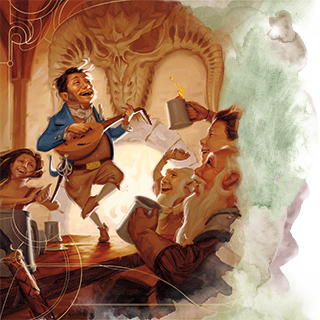
Halflings rarely consider leaving the security of their villages, because they already have all the comforts they could want -food, drink, laughter, family, friends, and the satisfaction of doing a good day’s work. When all their necessities have been taken care of, halflings take it easy and many of them find a way to turn idleness into an art form. Every halfling has a favorite spot for doing nothing -in the shade of a large stone, on the fringe of a sun-dappled meadow, or nestled in a comfy crook high in a tree.
When they’re not dozing off and dreaming of chasing butterflies, halflings spend time on simple creative activities, such as whittling a pipe from a branch, braiding yarn into a thick rope, or composing a jaunty tune on a second-hand mandolin.
Serious Business
The oldest members of a halfling community are its leaders, although that role has a special application. A clan’s elders aren’t authority figures in the traditional sense; they are respected, and their words are heeded, because of the stories they tell.
Their best tales deliver practical knowledge within the framework of a mythic saga. An elder doesn’t simply announce, “We must be always ready for a goblin attack.” Instead, that advice is delivered in a story about how a village long ago turned back a goblin invasion, which both entertains the villagers and teaches them what to do if goblin raiders find the village.
For the most part, halflings aren’t the targets of warring nations. Their villages are of little tactical value, nor are they likely to be coveted by evil wizards or to become the object of wrath for some dark force. The only enemies that a halfling village must watch for on an ongoing basis are roving bands of orcs or goblins, and the occasional hungry ogre or other solitary monster. And, as halfling luck would have it, these incidents are so rare that a single one might be talked about for generations.
Homes away from home
An individual halfling or a family might leave its community behind for a number of reasons. A clan that is forced to relocate (perhaps because of invading creatures or a natural disaster) might decide to seek refuge or opportunity in a city or town, rather than trying to find another secluded spot in the wilderness.
A city or a large town is likely to have a halfling neighborhood already, meaning that newcomers have a place to go that they can call home. Often, they join other halflings who have set up shop and support whatever enterprises their newfound friends have created, making a living as storytellers, bakers, chefs, or shopkeepers.
Halfling gods and myths
Halflings see their gods more as extended family members than as divine beings. They don’t worship them in the same way as elves and dwarves revere their gods, because the halfling gods are viewed as folk heroes - mortal beings who ascended to divinity, rather than divine entities who descend from their realms to influence the world. Because of this outlook, halflings rarely worship a single deity exclusively; they revere all the gods equally and pay their respects in modest ways.
Halflings speak of Yondalla the way humans would describe a strong and protective parent. They talk about Brandobaris as others might refer to a mischievous and dashing uncle. They don’t beseech the gods for daily favors, and they have no sense of metaphysical distance or separation between them and their gods. To halflings, their gods are part of the family. And as family members do, the gods set an example that is reaffirmed through the stories of their heroic deeds, with each tale helping to teach important lessons to the next generation.
The Halfling Deities table lists the members of the halfling pantheon. For each god, the table notes alignment, province (the god’s main areas of interest and responsibility), suggested domains for clerics who serve the god, and a common symbol of the god. Each of the gods in the table is described below.
-
Halfling Deities
Deity Alignment Province Domains Common Symbol Arvoreen LG Vigilance, war Heroism, Protection, War Crossed short swords Cyrrollalee LG Hearth, home Celebration, Charm, Life An open door Yondalla LG Primary goddess of halflings Fortune, Life, Protection Cornucopia Sheela Peryroyl NG Agriculture, nature, weather Air, Nature, Tempest A flower Brandobaris N Adventure, thievery Fortune, Trickery Halfling footprint Charmalaine N Keen senses, luck Fortune, Trickery, Whimsy Burning boot print Urogalan LN Earth, death Death, Earth, Life, Repose, Winter Silhouette of a dog’s head -
Yondalla,
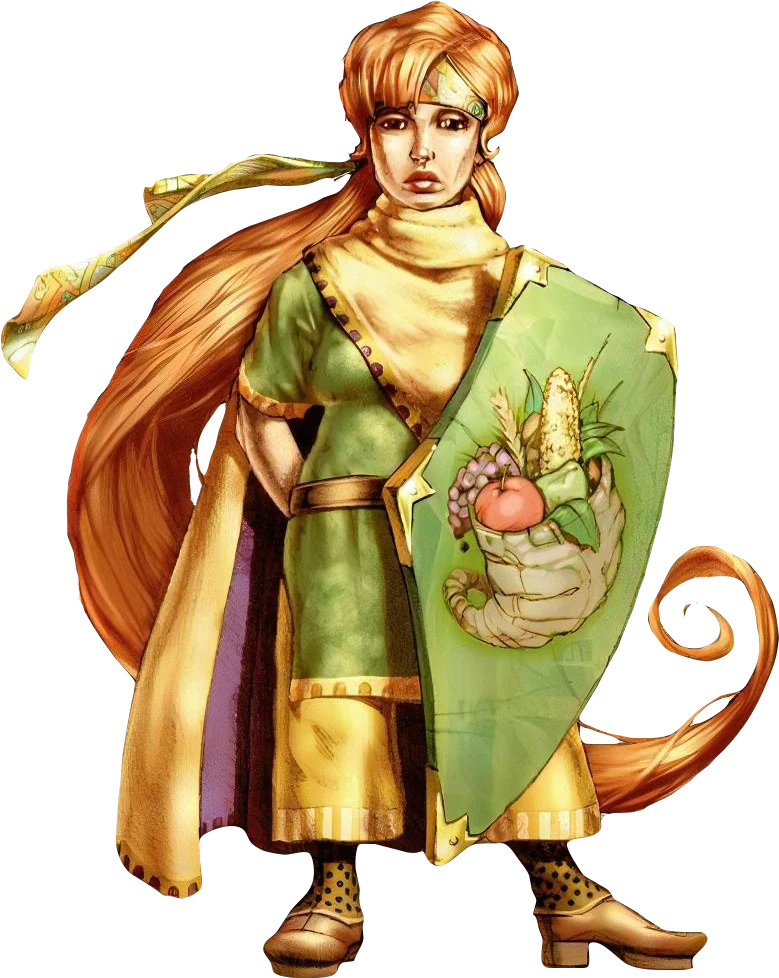 The story of Yondalla begins at the dawn of the world, when halflings were timid wanderers, scraping out a meager existence.
The goddess Yondalla took note of them and decided to adopt the halflings as her people.
She was a strong leader with a vision for her people, and she dedicated her life to gathering them together and protecting them.
Over time, she elevated to godhood those halflings who were the most adept at the skills halflings needed to survive.
Those legendary halflings comprise the rest of the pantheon.
The story of Yondalla begins at the dawn of the world, when halflings were timid wanderers, scraping out a meager existence.
The goddess Yondalla took note of them and decided to adopt the halflings as her people.
She was a strong leader with a vision for her people, and she dedicated her life to gathering them together and protecting them.
Over time, she elevated to godhood those halflings who were the most adept at the skills halflings needed to survive.
Those legendary halflings comprise the rest of the pantheon.Yondalla created the first halfling villages and showed the people how to build, plant, and harvest. She knew that the bounty of a halfling village would be tempting plunder for any brigand or monster, so she used her powers to conceal their homes from easy discovery, blending them into the landscape so that most travelers would pass by without a second glance. To the halflings, Yondalla is responsible for the spring in their step and the bubbly excitement they feel from knowing that luck is on their side. When a pumpkin grows to enormous size or a garden yields twice as many carrots as usual, credit goes to Yondalla. When a halfling trips, slides down a hillside, and lands on a nugget of gold, that’s Yondalla turning bad luck into good.
-
Arvoreen,
From time to time, halflings must fight to defend their friends or their village. In those moments, the tales of Arvoreen come to the fore in every halfling’s memory.Every youth hears over and over again the stories of the hero’s bravery and cunning, his clever tactics in battle, and his ability to use speed and smallness to defeat a much larger foe. The elders know that the world outside is dangerous and that their kin must understand how to deal with those dangers. Stories about Arvoreen are told in such a way that youngsters are inspired to act out his epic battles. In this way, the halflings get practical experience in executing measures that are designed to help the halflings defeat kobolds and goblin raiders, or even take down an ogre. When the time comes to put those tactics to use in earnest, everyone will be ready.
Cooperation is a fundamental principle in how halflings fend off their enemies. Every community practices its own version of Arvoreen’s favored tactics:
Scatterstrike. The halflings run in every direction as if in a panic, but then they regroup and circle back to attack with a concentrated effort.
Turtle Shell. Halflings cluster together and cover each other with shields, washtubs, wheelbarrows, coffer lids, or anything else that can deflect a blow.
Troll Knocker. A few halflings act as bait to lure a troll or other large creature into a clearing where the rest of the group can hurl stones at it from concealment to confuse the monster, persuading it to seek other prey.
Swarming Stickwhackers. Halflings rush an intruder in waves, swatting the enemy with sticks on all sides.
Fiddle and Crack. A halfling fiddler lures the monster into a trap, usually a net or a pit, followed by several burly halflings wielding large sticks and hitting the monster from a safe vantage.
-
Sheela Peroryl,
Every halfling village sets aside a place for paying respects to Sheela Peryroyl. In a grove of trees, a raspberry patch, or a swath of wildflowers, villagers leave a small offering whenever they walk by, or tip their caps, or whisper a blessing in her honor. A village counts itself lucky if this place is cared for by a druid. Creatures that attack a village under the protection of the god’s druids soon learn the error of their ways when all manner of plants lash out to grapple and sting the intruders, as though nature herself were aiding the halflings’ cause.On nights when the moon is full, especially during the planting and harvesting seasons, the elders tell stories about Sheela Peryroyl. After becoming a hero through her glorious adventures, Sheela joined with the earth, fusing her spirit with the flowers, plants, and trees so she could better provide for her kin. A halfling who accidentally steps on a flower often says, “Begging your pardon, Sheela.” Before halflings cut down a tree to use its wood for a new house, it is customary for them to stand before the tree with their caps doffed, humbly asking permission from Sheela to continue.
-
Charmalaine,
Charmalaine is an energetic and spontaneous deity, unafraid of danger, for she expects to be able to detect it as it approaches and evade it before it brings her harm.The stories of her accomplishments read like an adventurer’s wildest dreams: she escaped from an army of sahuagin, solved the Chamber of a Thousand Traps, and took treasure from the lair of Tiamat. Halflings envision her as a young adult who moves so fast that her boots smoke and sometimes even catch fire. She carries a mace that has a head that shouts out warnings, and she is accompanied by her ferret friend, Xaphan.
Halflings sometimes call Charmalaine the Lucky Ghost because she can send her spirit out of her body to scout ahead, and thus she is able to warn halfling adventurers of danger while in her incorporeal form. Halflings who favor Charmalaine are usually adventurers or those who pursue other risky professions such as hunting, beast training, scouting, and guarding public officials.
-
Cyrrollalee,
Cyrrollalee embodies the spirit of friendship and hospitality that is part of every halfling’s makeup and is represented by one’s home and hearth. The home is a welcoming place, but it is also sacrosanct. Halflings honor Cyrrollalee by opening their homes to visitors, and by respecting the home of one’s host as if it were one’s own.Every halfling village tells its version of the legendary tale of Cyrrollalee and the troll pies. Long ago, a large human town near Cyrrollalee’s village was regularly attacked by a vicious troll. Warriors from the town hacked at the troll, but even its most dire wounds would heal, and the troll would come back again. One day Cyrrollalee presented herself at the town gate in apron and peasant clothes, and she offered to rid the town of the troll. The proud human warriors all scoffed at her, but the desperate mayor asked Cyrrollalee for her help.
So Cyrrollalee set all the people in the town to baking pies, but not just any pies. They were special troll pies. Into each one she put a pinch of magic to make them irresistible to trolls. While the warriors of the town grumbled and sharpened their steel, Cyrrollalee created an atmosphere of fun, bringing cheer to the frightened people as they worked.
When the day was done, she set off with a cart full of pies and laid them in a tasty trail far up into the mountains. When the troll came near the town and found the trail, it began to gobble up pie after pie, following the delightful smells up the mountain path until it walked right into the lair of a young red dragon. The greedy troll was swiftly incinerated. Cyrrollalee returned a hero, and from that day forward all the townsfolk remembered her with a word of thanks when baking pies.
-
Brandobaris,
Dashing trickster, patron of thieves, and star of fantastical fables and wild stories of adventure - that’s the legacy of Brandobaris, the Master of Stealth. Stories of Brandobaris, full of artful trickery and narrow escapes, inspire many young halflings to play at roguish pursuits.In their imagination, a grain silo becomes a lofty wizard’s tower to scale in search of treasures, or a rowboat becomes the setting for a swashbuckling adventure. And for some -the youngsters who are said to “have a bit of Brandobaris in them” - that play-acting is the prelude to a life of living as Brandobaris does: always on the lookout for the next challenge.
Brandobaris continues to wander in search of excitement, and now, as an ascended being, his travels span the planes of existence. His curiosity takes him to all corners of the multiverse in search of magical curios, rare treasures, and mystical puzzles. When Brandobaris moves stealthily, no mortal or god can hear his footfalls - an ability he uses not only for defense, but also to bestow unlooked-for treats upon those he favors.
Although he never seems to rest in his travels, Brandobaris always has time to reward halflings who dare to take risks and explore the world to make their own mark on it. He has been known to give a bit of aid to halflings in dire straits, turning them invisible for a time or intervening so that they can’t be heard or tracked.
-
In ancient times the halfling hero Urogalan left his village with his faithful hound to venture into the afterlife, and then, much to the villagers’ amazement, he returned. They could see that Urogalan had been deeply affected by his experiences, since he didn’t speak for a long time. He merely sat in a white robe with his hound by his side, watching the world go by. When he did speak at last, he told of a place he called the Green Fields, where the halflings’ god-heroes live alongside mortals who have passed on, enjoying lush farmland, bright sunshine, and all the comforts of home.
Urogalan declared that all who have gone before still watch over their loved ones from this place of eternal peace, sending messages to the material world. In acknowledgment of this assertion, halflings look for signs from their departed loved ones. One might be thinking about catching butterflies with his grandmother long ago, when suddenly a butterfly lands on his hand - clear evidence that, as Urogalan promised, she is still looking out for her grandson from beyond the veil of death.
As a divine being, Urogalan can move freely through the earth and across the planes of existence. He holds aloft a magic lantern that protects him on his journeys. With his black hound leading the way, Urogalan scours the multiverse and shepherds deceased halflings to their eternal home in the Green Fields.
Unlike other halfling deities, Urogalan is surrounded by a cloud of melancholy. He is gaunt, with his dusky skin covered by white robes. Priests who venerate Urogalan emulate this practice of dress and demeanor.
The Halfling Adventurer
Everything about halflings, from their small stature to their easy demeanor, makes them unlikely candidates for taking up a life of adventure away from home. Yet every generation produces a handful of exceptional individuals who defy conventional wisdom and seek their fortunes in the wider world.
Opinions vary on what compels some halflings to leave home and set off over the farthest hill to explore the unknown. The simplest explanation is that some folk are born with an overabundance of curiosity. Some say that Arvoreen or Brandobaris is responsible for urging them on, and others point to the stories told by the elders that inspire some youngsters to take such risks.
“Who knows where a hero’s spirit will grow? Even the smallest seed can produce the mightiest tree.”
– Elminster Aumar, Sage of Shadowdale
Whatever the reason, from time to time a halfling feels the call of adventure and sets off with a walking staff, a satchel, and a few biscuits. The first stop for many of these plucky souls is a faraway city where they hope to find some like-minded companions.
Fancy feet
A halfling’s potential for adventuring usually manifests early in life. When a child first wanders away from the village, seemingly by accident, or one day hops on a log and tries to set off down the river, the parents are concerned but not alarmed. They attribute these acts of rambunctiousness to Brandobaris’s meddling, and almost all children outgrow this tendency to put themselves at risk. But if one persists in these antics, the other villagers say the youngster has “fancy feet.”
The term refers to the persistent urge to wander beyond the boundaries of the community, an activity that is in the purview of Brandobaris, who is said to have “the fanciest feet of all.” Each village has its own way of coping with this phenomenon. Some elders -especially those who once had fancy feet themselves- just shrug, smile, and say it is the way of things.
Nevertheless, well-meaning villagers might try to dissuade a youngster from leaving the community. Other villages are much more supportive of one of their members who demonstrates the urge to adventure, likely because some of their elders have gone into the world and returned to tell about it. In one of these places, a youngster about to set out is celebrated with a rousing party that goes far into the night, during which the adventurer-to-be is regaled by tales of other “fancy-footed” heroes of halfling history.