Traits
The different types of gnomes
Forest Gnome
Rock Gnome
Deep Gnome
Class options
The Gnome Race
Drinking deeply of life
Rock Gnomes
Forest Gnomes
Deep Gnomes
Gnome Gods
Gnome Adventurers
Gnome
As far as gnomes are concerned, being alive is a wonderful thing, and they squeeze every ounce of enjoyment out of their three to five centuries of life. Humans might wonder about getting bored over the course of such a long life, and elves take plenty of time to savor the beauties of the world in their long years, but gnomes seem to worry that even with all that time, they can’t get in enough of the things they want to do and see.
Gnomes speak as if they can’t get the thoughts out of their heads fast enough. Even as they offer ideas and opinions on a range of subjects, they still manage to listen carefully to others, adding the appropriate exclamations of surprise and appreciation along the way.
“Skinny and flaxen-haired, his skin walnut brown and his eyes a startling turquoise, Burgell stood half as tall as Aeron and had to climb up on a stool to look out the peephole. Like most habitations in Oeble, that particular tenement had been built for humans, and smaller residents coped with the resulting awkwardness as best they could.
But at least the relative largeness of the apartment gave Burgell room to pack in all his gnome-sized gear. The front room was his workshop, and it contained a bewildering miscellany of tools: hammers, chisels, saws, lockpicks, tinted lenses, jeweler’s loupes, and jars of powdered and shredded ingredients for casting spells. A fat gray cat, the mage’s familiar, lay curled atop a grimoire. It opened its eyes, gave Aeron a disdainful yellow stare, then appeared to go back to sleep.”
– Richard Lee Byers, The Black Bouquet
Vibrant Expression
A gnome’s energy and enthusiasm for living shines through every inch of his or her tiny body. Gnomes average slightly over 3 feet tall and weigh 40 to 45 pounds. Their tan or brown faces are usually adorned with broad smiles (beneath their prodigious noses), and their bright eyes shine with excitement. Their fair hair has a tendency to stick out in every direction, as if expressing the gnome’s insatiable interest in everything around.
A gnome’s personality is writ large in his or her appearance. A male gnome’s beard, in contrast to his wild hair, is kept carefully trim med but often styled into curious forks or neat points. A gnome’s clothing, though usually made in modest earth tones, is elaborately decorated with embroidery, embossing, or gleaming jewels.
Seeing the World
Curious and impulsive, gnomes might take up adventuring as a way to see the world or for the love of exploring. As lovers of gems and other fine items, some gnomes take to adventuring as a quick, if dangerous, path to wealth. Regardless of what spurs them to adventure, gnomes who adopt this way of life eke as much enjoyment out of it as they do out of any other activity they undertake, sometimes to the great annoyance of their adventuring companions.
Gnome Names
Gnomes love names, and most have half a dozen or so. A gnome’s mother, father, clan elder, aunts, and uncles each give the gnome a name, and various nicknames from just about everyone else might or might not stick over time. Gnome names are typically variants on the names of ancestors or distant relatives, though some are purely new inventions.
When dealing with humans and others who are stuffy about names, a gnome learns to use no more than three names: a personal name, a clan name, and a nickname, choosing the one in each category the most fun to say.
-
Male Names: Alston, Alvyn, Boddynock, Brocc, Burgell, Dimble, Eldon, Erky, Fonkin, Frug, Gerbo, Gimble, Glim, Jebeddo, Kellen, Nam foodle, Orryn, Roondar, Seebo, Sindri, Warryn, Wrenn, Zook
-
Female Names: Bimpnottin, Breena, Caramip, Carlin, Donella, Duvamil, Ella, Ellyjobell, Ellywick, Lilli, Loopm ottin, Lorilla, Mardnab, Nissa, Nyx, Oda, Orla, Roywyn, Shamil, Tana, Waywocket, Zanna
-
Clan Names: Beren, Daergel, Folkor, Garrick, Nackle, Murnig, Ningel, Raulnor, Scheppen, Timbers, Turen
-
Nicknames: Aleslosh, Ashhearth, Badger, Cloak, Doublelock, Filchbatter, Fnipper, Ku, Nim, Oneshoe, Pock, Sparklegem, Stumbleduck
Gnome traits
Your gnome character has certain characteristics in common with all other gnomes.
-
Ability Score Change. Your Luck ability score, both current and maximum, increases by 2, while your Strength ability score, both current and maximum, is reduced by 4.
-
Age. Gnomes mature at the same rate humans do, and most are expected to settle down into an adult life by around age 40. They can live 350 to almost 500 years.
-
Alignment. Gnomes are most often good. Gnomes are good-hearted, and even the tricksters among them are more playful than vicious.
-
Size. Gnomes are between 3 and 4 ft tall and average about 40 pounds. Your size is Small.
-
Speed. Your base speed is 25 ft.
-
Low-light Vision. Accustomed to living in dark burrows, you have superior vision. You can see in dim light as if it were bright light and an additional 60 ft into darkness as if it were dim light.
-
Gnome Cunning. You have advantage on all Intelligence and Charisma saving throws against magic.
-
Subtype. There are three types of gnomes; forest gnomes, rock gnomes (also known as tinker gnomes), and the more uncommon deep gnome.
Forest Gnome
The rare and secretive forest gnomes, have a natural knack for illusion and inherent quickness and stealth. They gather in hidden communities in sylvan forests, using illusions and trickery to conceal themselves from threats or to mask their escape should they be detected. Forest gnomes tend to be friendly with other good-spirited woodland folk, and they regard elves and good fey as their most important allies. These gnomes also befriend small forest animals and rely on them for information about threats that might prowl their lands.
-
Ability Score Increase. Your Wisdom ability score, both current and maximum, increases by 2.
-
Languages. You know Common and Sylvan.
-
Natural Illusionist. You know the minor illusion cantrip. Wisdom is your spellcasting ability for it.
-
Speak with Small Beasts. Through sounds and gestures, you can communicate simple ideas with Small or smaller beasts. Gain the Animal Handling - Forest animals skill. Forest gnomes love animals and often keep squirrels, badgers, rabbits, moles, woodpeckers, and other creatures as beloved pets.
-

Rock Gnome
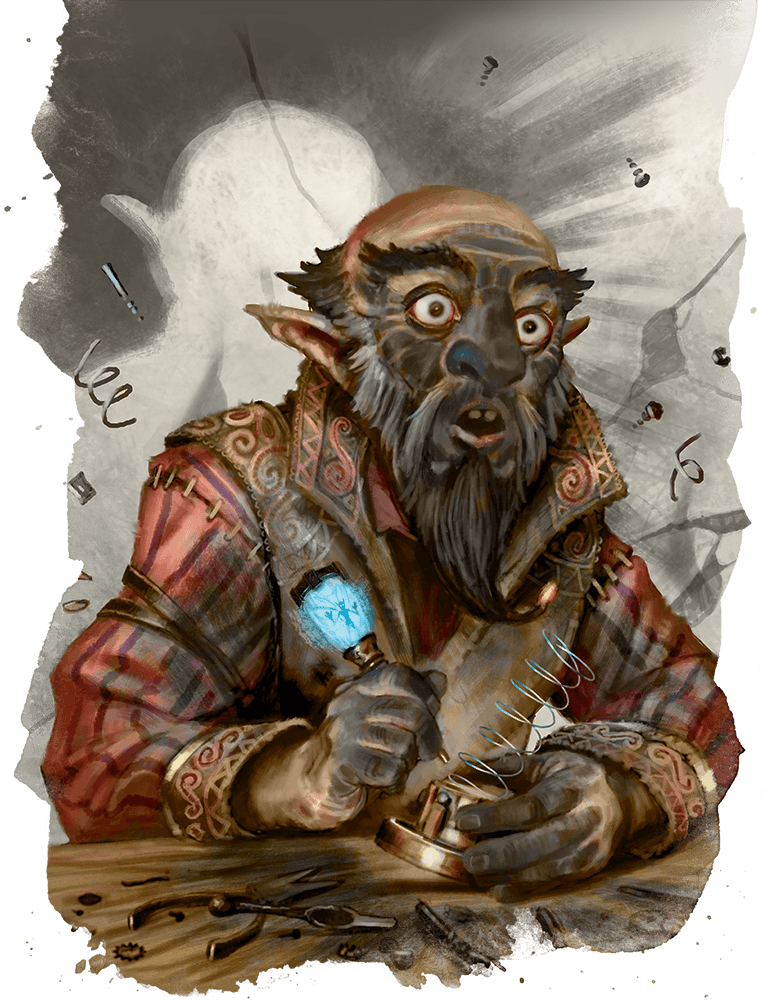
As a rock gnome, you have a natural inventiveness and hardiness beyond that of other gnomes. These are the types of gnomes most common, and the ones that people usually associate to when hearing about gnomes.
A constant hum of busy activity pervades the warrens and neighborhoods where the rock gnomes form their closeknit communities. Louder sounds punctuate the hum: a crunch of grinding gears here, a minor explosion there, a yelp of surprise or triumph, and especially bursts of laughter. Gnomes take delight in life, enjoying every moment of invention, exploration, investigation, creation, and play.
-
-
Ability Score Increase. Your Intelligence ability score, both current and maximum, increases by 2.
-
Languages. You know Common and Gnomish. The Gnomish language is renowned for its technical treatises and its catalogs of knowledge about the natural world.
-
Artificer’s Lore. Whenever you make an History check related to magic items, alchemical objects or technological devices, you have advantage.
-
Tinker. Gain the skill Engineering - Tinkering - Gnomish tinkering and all its prerequisites. Using a set of tinker’s tools, you can spend 1 hour and 10 gp worth of materials to construct a Tiny clockwork device (AC 5, 1 hp). The device ceases to function after 24 hours (unless you spend 1 hour repairing it to keep the device functioning), or when you use your action to dismantle it; at that time, you can reclaim the materials used to create it. You can have up to three such devices active at a time.
When you create a device, choose one of the following:
-
– Bouncing Boots. A pair of metal-reinforced boots with multiple coils and a ratchet-system between a steel innersole and a leather-bottomed outer sole, bouncing boots are guaranteed to add a spring to anyone’s step. Using them requires unlocking them by hand and jumping upwards to ‘prime them’. Six seconds after landing, the timed ratchet releases and the coils unwind violently, propelling the wearer 15 ft. A successful Acrobatics check against DC 10 allows the wearer to guide this sudden movement in any direction desired; otherwise the jump occurs in a random direction. Colliding with a solid object larger than the wearer during a jump results in 1d6 points of damage. When the user lands, he must spend his next round relocking the boots. Failure to do so results in another 15 ft jump the next round.
-
– Clockwork Toy. This toy is a clockwork animal, monster or person, such as a frog, mouse, bird, dragon or soldier. When placed on the ground, the toy moves 5 ft across the ground on each of your turns in a random direction. It makes noises as appropriate to the creature it represents.
-
– Fire Starter. The device produces a miniature flame, which you can use to light a candle, torch or campfire. Using the device requires your action.
-
– Music Box. When opened, this music box plays a single song at a moderate volume. The box stops playing when it reaches the song’s end or when it is closed.
-
– Shield, Retractable. Due to the ingenuity of gnomes, the retractable shield has come from the depths of imagination to the reality of the battlefield. Though it initially appears to be the size of a buckler, the retractable shield can be expanded with the pulling of a release key. Upon release the fans that make up the retractable shield spread out and become a large shield. Retractable shields require one minute to retract to their original state and this is done by turning the key until the fans that make up the shield lock into place.
-
– Shield, Widowmaker. This strange, gnomish device appears to be an ordinary shield with pyramidlike protrusions around the periphery. The shield works similarly to a bear trap in that, when the shield is struck and the character releases the trip-cord, it snaps shut. Thus, if an opponent misses the bearer of a widowmaker shield by two or less on an attack roll, the character may choose to release the trip-cord and have the shield attempt to close on the opponent’s weapon. The opponent must make a Dexterity save (DC 10) or have the item they were wielding become trapped in the shield’s grip (Strength check DC 10 to break the widowmaker’s grip). If the opponent was using his bare fist to strike at the character with the widowmaker and they fail their save, their hand becomes trapped instead. Once a widowmaker shield is triggered the character loses the AC bonus from the shield. A widowmaker shield takes one minute to reset.
Deep Gnome
Forest gnomes and rock gnomes are the gnomes most commonly encountered in the lands of the surface world. There is another subrace of gnomes rarely seen by any surface-dweller: deep gnomes, also known as svirfneblin. Guarded, and suspicious of outsiders, svirfneblin are cunning and taciturn, but can be just as kind-hearted, loyal, and compassionate as their surface cousins.
Born of Deep Earth
Svirfneblin seem more like creatures of stone than flesh. Their leathery skin is usually a gray, brown, or dun hue that acts as a natural camouflage with the rock around them. Their bodies are gnarled with hard muscle or fat, and they are heavier than their small stature suggests; svirfneblin often weigh 100 pounds or more but rarely stand much more than 3 feet tall.
Male svirfneblin are bald from early childhood, although adults can grow stiff beards or mustaches. Females have full heads of hair, and they usually tie their hair back in braids or cut it short to keep it from getting in their way as they work.
Svirfneblin are well adapted for their subterranean existence. They have excellent darkvision, and many of them have magical talents that rival the innate spellcasting of the drow and duergar. They are surprisingly strong for their size, enduring toil and danger that would overwhelm most other people.
Deep Gnome Names
Svirfneblin prefer less flamboyant names than their rock gnome or forest gnome cousins. Clan names reflect skills or occupations that a particular family is associated with, and sometimes change if a noteworthy individual strikes out in a new direction.
-
Male Names: Belwar, Brickers, Durthmeck, Firble, Krieger, Kronthud, Schneltheck, Schnicktick, Thulwar, Walschud
-
Female Names: Beliss, Durthee, Fricknarti, Ivridda, Krivi, Lulthiss, Nalvarti, Schnella, Thulmarra, Wirsidda
-
Clan Names: Crystalfist, Gemcutter, Ironfoot, Rockhewer, Seamfinder, Stonecutter
Deep Gnome Traits
Short-lived compared to other gnomes, deep gnomes mature at the same rate humans do and are considered full-grown adults by age 25. They live 200 to 250 years, although toil and the dangers of the Underdark often claim them before their time.
Svirfneblin believe that survival depends on avoiding entanglements with other creatures and not making enemies, so they favor neutral alignments. They rarely wish others ill, and they are unlikely to take risks on behalf of others, except those dearest to them.
-
Ability Scores. You do not apply the gnome Ability score changes.
-
Languages. You know Undercommon.
-
Darkvision. For 30 ft around you, you can see in darkness as if it were dim light. You can’t discern color in darkness, only shades of grey.
-
Stone Camouflage. You have advantage on Stealth checks to hide in rocky terrain.
-

Gnome Class Options
An gnome approaches some classes is a bit different than other races. When you select one of these classes, it is modified as follows:
-
Alchemist
Rock gnomes like explosions and naturally gravitate toward the mad bomber archetype. Whenever the Alchemist class description mentions your Intelligence modifier, you may instead use your proficiency bonus.
-
Barbarian
Gnomes are not really built for this class. They neither have the physique, nor the anger that makes for a fearsome barbarian.
-
Bard
A gnome bard can use his bardic inspiration to cause one or more creatures to become furious with him.
Mock
You can mock a number of creatures up to 1d6 + your proficiency modifier. Each target must be able to see, hear, and understand you. They receive a Wisdom save (DC 10 + your proficiency bonus + your Charisma modifier). If the saving throw succeeds, you cannot successfully mock that creature for 24 hours. If the saving throw fails, the creature is angered by the performance and seeks to harm you. You can maintain this as a concentration effect, allowing the mocked creatures a new Wisdom save at the end of each of its turns. While you maintain the mocking, the targets has disadvantage on all attack rolls and skill checks until it has successfully damaged you.
In addition, whenever the Bard class description mentions your Charisma modifier, you may instead use that modifier +3 or your proficiency bonus, whichever is lower.
-
Cavalier
Forest gnomes get very well along with all kinds of animals, and they can be seen riding all kinds of animal, from badgers to moose. With the help from their friends they are very adept on the back of a ridden animal.
Whenever the Cavalier class description mentions your Strength or Charisma modifier, you may instead use that modifier +3 or your proficiency bonus, whichever is lower. This also applies to attack and damage rolls.
-
Cleric
Gnomes are like most other humanoids in regards of religion.
If you are a cleric following a gnome deity and one of its domains, then whenever the cleric class description mentions your Wisdom modifier, you may instead use your proficiency bonus.
-
Cursed
Due to their curiosity, rock gnomes have a higher amount of cursed than any other race. However, any gnome can be cursed.
You may choose Wisdom or Charisma as your spellcasting ability instead of Intelligence. You make this choice at level 1 and cannot change this later.
-
Druid
Forest gnomes are very much in tune with nature and gain the critter friend feat at level 1. In addition, whenever the druid class description mentions your Wisdom modifier, you may instead use your proficiency bonus.
-
Feyblood
Forest gnomes commonly gain the Sidhe or Sprig affinity, and if so, gain the fade away feat at level 1.
Rock gnomes most commonly have the pooka affinity, and if so, gain +2 to their Luck ability.
Deep gnome often have the oread affinity, and if so, gain the svirfneblin magic feat at level 1.
-
Fighter
Deep gnome fighters may can add the following fighting style to their selection of fighting styles.
And then I did anyway…
They told you it was too big and that you shouldn’t train with it. And then you did anyway. Through perseverance, you have managed to overcome your size. You can use weapon with the Heavy property without disadvantage.
Rock gnomes have access to the Tinker knight archetype.
-
Inquisitor
Gnomes mostly ignore the religious practices of other creatures, so the inquisitor role does not really exist.
-
Paladin
Paladins are very rare but they do exist among gnomes, and are then the embodiments of the heroic ideals for their race. This often confuses people when they first meet a gnome paladin, as they expect a paladin to follow the human ideals.
Suitable archetypes are oath of the ancients for forest gnomes, oath of tomorrow for rock gnomes and oath of tradition for deep gnomes.
Whenever the Paladin class description mentions your Charisma modifier, you may instead use your proficiency bonus.
In addition you can add the fighting style from the fighter entry to your selection of fighting styles.
-
Professional
Rock gnomes can become very good professionals, not necessarily because they are good at crafting, but because of their love for experimentation. This mostly ends in disaster, but can also result in great leaps of progress.
Deep gnome societies are usually completely isolated from other settlements, which forces them to have specialists of different kinds. However, they tend to prefer and value the more practical fields, like the candlemaker, cook or smith.
If you are a deep gnome in a more practical field, or a rock gnome, then whenever the Professional class description mentions your Wisdom modifier, you may instead use this modifier +3 or your proficiency bonus, whichever is lower.
-
Ranger
As a gnome ranger you have access to the Trickster conclave.
Whenever the Ranger class description mentions your Wisdom modifier you may instead your proficiency bonus. In addition, you may use the same modifier instead of Strength or Dexterity when attacking (attack and damage). Make this choice at level 1 and it cannot be changed later.
Finally you can add the fighting style from the fighter entry to your selection of fighting styles.
-
Rogue
Forest gnomes are really sneaky. You may use your Dexterity modifier +3 or your proficiency bonus when calculating AC and when attacking (to hit and damage).
In addition, when using sneak attack, you can opt not to use all your sneak attack dice. For each die you did not use, you gain a +1 to AC until the start of your next turn. Note that you can sneak attack using 0 extra damage dice.
-
Sorcerer
Sorcerers are just as rare and varied as within other folk.
Whenever the Sorcerer class description mentions your Charisma modifier, you may instead use your proficiency bonus.
A forest gnome sorcerer may add one illusion spell per spell level from any class list to its spell list.
-
Swashbuckler
As forest gnomes and rock gnomes are usually too weak to use heavier armor, the swashbuckler class is preferred over the fighter class.
Whenever the Swashbuckler class description mentions your Intelligence modifier, you may instead use your proficiency bonus.
In addition you can spend 1 panache to use mock, as the gnomish bard.
-
Warlock
Just as any other folk, gnomes sometimes want to take shortcuts to power, safety, knowledge or, as is the case for rock gnomes, just for curiousity and fun.
Whenever the Warlock class description mentions your Charisma modifier, you may instead use your proficiency bonus.
-
Wizard
Rock gnomes are very curious and some become fascinated with the arcane arts. Whenever the Wizard class description mentions your Intelligence modifier, you may instead use your proficiency bonus. You may only do this if you are literate.
The Gnome Race
Love of discovery is the force that drives the life of a gnome, whether one is investigating the nature of magic or trying to invent a better back scratcher. Questions about the world fill a gnome’s head: how an insect flies, a fish swims, or a grasshopper jumps -they want to figure it all out! But it’s not just nature and its workings that intrigue them; gnomes become obsessed with all sorts of topics. In particular, they have a keen interest in mechanical devices, the natural world, and magical pursuits; a gnome might seek to invent a new garden tool, collect and categorize every type of butterfly, or develop a new method for cutting gemstones.
“And then the whole thing exploded into a million jillion pieces! {gasp} I never saw anything like it in my life!”
– Griballix, gnome of Sigil
Drinking deeply of life
A gnome is rarely bored and tries to savor every minute, for life is full of opportunities to learn, to help others, and to have fun.
Gnomes are born with a fascination for learning fueled by an irrepressible curiosity. Most individuals settle on a specialized area of study such as an aspect of the natural world, a particular method of invention, or the patterns that underlie the multiverse.
Though this pursuit of knowledge might compel a gnome to spend long periods in the workshop or the laboratory, the activity is never seen as drudgery -quite the opposite. Gnomes enjoy making an unexciting aspect of life more enjoyable, such as inventing a shovel that whistles a tune to lighten the toil of digging, or creating a telescoping fork that can reach across the table to enliven mealtime.
Their fun-loving attitude also comes through in the form of jokes that gnomes tell to, or about, their companions, and in the good-spirited pranks that they play on each other-and on other folk (who might not always appreciate being the target of their humor).
The journey is the destination
Gnomes aren’t overly goal-oriented as they pursue their interests. To them, the journey and the destination are one and the same, and an achievement at the end of one journey is merely the first step toward the next accomplishment.
Even though failure, disappointment, and dead ends are recurring obstacles on the path to discovery, gnomes revel in the search. They savor the acquisition of new knowledge, realizing it might come at a cost, and even a series of bad results in experiments doesn’t dissuade a gnome from following their chosen path.
Rock Gnomes
A visitor’s first steps into a rock gnome warren are accompanied by the sounds of industry -hammers rapping on metal, chisels chewing wood, cauldrons bubbling, and a host of assorted squeaks, pings, and whistles.
Against this backdrop, the halls echo with the voices of rock gnome inventors jabbering at near unintelligible speed about their latest ideas, and the hubbub is occasionally punctuated by a big bang or the abrupt collapse of some unstable contraption.
To rock gnomes, life is a combination of scavenger hunts and periods of bold experimentation. First they mine materials from within the earth, and then they figure out what they can create or invent using those resources.
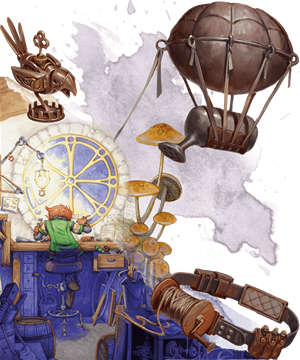
The discovery of a new vein of metal -whether tin, copper, silver, or gold- makes rock gnomes clap their hands with glee, but they are happiest of all when they find a cache of gems, particularly diamonds.
Individual rock gnomes have different ideas about what sorts of inventions are the most satisfying to create, with some favoring practicality and others more interested in artistic expression. In each group, there are those who prefer to practice the alchemical arts and those whose talents lean toward the creation of mechanical devices. Every warren has members of each persuasion, and they are all bound by mutual respect for what they do despite their different perspectives.
Practical makes perfect
Rock gnomes who take a more scientific approach to inventing are the ones responsible for creating technological devices that make life easier. Even an invention as simple as a new kind of rake is celebrated, and that advance might later be superseded by someone who modifies it in a way that makes it more efficient or more enjoyable to use.
These inventors are rarely reluctant to try making devices of exceptional power, even if one might not work at first the way it was intended to. The gnomes know that it’s always possible for someone else to learn from an inventor’s mistakes, so even a failed experiment is a success in some way. Every minor explosion or other incident of turmoil in a rock gnome burrow serves as a clue about what not to do next time -unless, of course, the goal was to make something explode.
For beauty’s sake
Imagination runs wild in the mind of a gnome. Any fresh idea can be the starting point for a new journey of experimentation and discovery. Even though rock gnomes appreciate the practical aspects of their endeavors, they also find satisfaction in creating items that have no true usefulness. Many an invention is celebrated just for being beautiful to behold or for being complex and intricate in its construction, and the artists who create such things are as esteemed as those who specialize in designing tools.
Exploration is a part of invention, as the gnomes see it, so there’s nothing wrong with creating machines and artifacts that seem to have no purpose. The gnomes who produce these works of art are using new ideas and new approaches, breaking through old boundaries and advancing the frontier of knowledge. For instance, an artist might create a beautiful articulated sculpture whose pieces can be manipulated in a unique way. Another artisan might take that idea and apply it to a new form of invention -but no one forgets that it was the artist’s idea that blazed the trail for that journey.
Alchemists
Rock gnome alchemists explore the nature of minerals and chemicals, curious to see what happens when they mix certain substances with other compounds or with raw magic. Most alchemists, even those who busy themselves with experimentation and new ideas, can produce a number of useful substances, such as alchemist’s fire, antitoxin, super slippery goo, stone melting compound, stirge repellent, and glow-in-the-dark paint.
Artificers
Rock gnome artificers construct exquisitely tooled and enameled pieces of machinery, often weaving magical properties into their work. Artificers often develop a reputation for a particular style and type of work. For example, a friendly gnome artificer might create lovable mechanical pets and companions, while a grumpy gnome might make snapping critter constructs with sharp teeth and claws. Gnome artificers can become famous, with their works highly sought after by nobles, wizards, and other collectors.
An artificer’s inventions might include items such as a lock box that opens with a verbal command or a series of gestures, a clockwork critter designed to respond to simple commands, or a common magic item.
Tinker gnomes
Some gnomes take invention to extreme heights and are known for being purveyors of madcap mayhem. Despite losing body parts or gaining scars from various accidents, nothing stops the tinker gnomes’ insatiable quest to experiment and discover.
Go Big or Go Home. The creations of tinker gnomes range from the ridiculous to the dangerous. They love to push the art of invention beyond its limits, and to explore the instability of volatile materials. They cackle with glee after an ear-splitting bang, and jump and cavort amid lethal sprays of lightning. Though it might be bizarre and unusual, a working tinker gnome creation is a rare thing, and highly prized. Such inventions include the following:
- A chain-driven tomato smasher that is also able to fly
- A lightning-powered portable rat-zapper: good for keeping out the vermin
- A floating metal facsimile of a beholder, complete with disintegrating eye rays
- A flock of exploding parrots
Fail Often, Fail Happy. These inventors are delighted by every explosion, every melted mess, and every heap of smoking wreckage. Failure is part of the eventual solution and something to be celebrated. A truly epic failure might be cause for a great celebration in the community.
Tunnel Vision
When they are at work, rock gnomes hole up in their workshops with “Do Not Disturb” signs hung on the door. It isn’t uncommon for gnomes who are working on their projects to spend most of their time in seclusion, and even when they emerge (for meals or other reasons), they are often deep in thought and oblivious of their surroundings. In the safety of the burrow, they seldom come to harm because of this vulnerability. But even city-dwelling gnomes can fall prey to this sort of obsession as they pursue their projects, and in such cases it’s much safer for them to stay in their homes, since a gnome wandering the streets deep in thought is liable to walk into a moat or be run over by a wagon.
Forest Gnomes
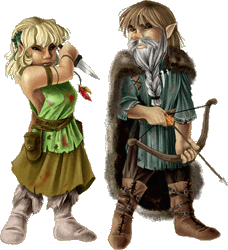
As the companions of nature and its animals, forest gnomes learn from their surroundings as if from a master teacher. They evade incursions into their wooded realm by great numbers of humans and other races, but they aid individuals and small groups whom they deem worthy of their help. They create lovely gardens, organic sculptures, and wondrous emerald jewelry- that precious green stone being their favorite of all gems.
Forest gnome settlements often escape notice. Roving hunters can wander through without ever suspecting they are walking through anything but wilderness. A community of elves might be surprised to discover they have been neighbors of a forest gnome village for years.
Forest gnomes are good at making their homes vanish into the landscape. It helps that they are small folk, and that they fashion their homes by digging down and living within rather than building up and living above. Like the badgers and raccoons that are often their companions, they live in the hollows of trees and warrens dug into hillsides, each home connected to the others in the community by elaborate burrows.
Beyond the secret doors into their houses, the homes of forest gnomes are gaily decorated, tidy spaces that take advantage of natural features. A great glass bowl swimming with fish and frogs might serve as a skylight for a gnome burrow, while appearing to the world above as a small pond. The gnarled and tangled roots of a tree might be used for shelves, seats, tables, and bed spaces. Such houses often have many little channels open to the outside, allowing scraps of sunlight to dapple the walls and floors and providing a means of egress for the many animals that live with the gnomes. Similar small openings are used for their cleverly hidden chimneys, disguised as tree branches, which carry smoke from their small fires high into the treetops, reducing it to little more than a haze before it disperses.
Animal helpers
Forest gnomes can communicate with many of the small animals of the woods. Squirrels, raccoons, foxes, weasels, owls, rabbits, robins, hummingbirds, and more are their allies and friends. Outsiders often think of these creatures as the gnomes’ pets, but the gnomes treat them more like trusted neighbors.
When strangers approach a woodland inhabited by forest gnomes, the gnomes often know about it while such visitors are still miles away. Speedy squirrels run through the treetops, each trying to be the first to warn the gnomes and earn a sweet treat. Birds trill a special call that alerts the gnomes to danger. At night, nocturnal animals such as owls and bats carry word to the gnomes during times when they should be on their guard.
Experts in illusion
Forest gnomes have innate magical ability, letting them create simple illusions. They practice the use of illusion magic from an early age. Most forest gnome communities include a full-fledged illusionist and an apprentice or two, and they use their talents in service of the community- designing longer-lasting or larger-scale illusions that help the community stay hidden from the world.
Gnomes use illusions for practically any reason -as a game, for defense, or for communication- and sometimes for no reason other than artistic considerations. A simple illusion can often express a complex idea, such as when the memory of a location is triggered by the illusory sound of a babbling brook that runs through the place. A storytelling session conducted by a group of forest gnomes is a riot of sounds and images that helps give meaning and intensity to the tale being told. It is a kind of entertainment unfathomable by most other races, whose stories and performances are limited by whatever materials are on hand.
The forest gnomes’ playful nature shows through in the illusions they create, even those that have a serious purpose. (An illusion that conceals the entrance to a tunnel by making it look like solid earth might not amuse other folk, but the gnomes get a good laugh out of it.) Forest gnomes spend their spare time experimenting with the creation of never-before-seen illusions, or embellishing the images and sounds they already know how to produce.
The number of ways in which forest gnomes use illusions to have fun is nearly limitless. A few examples: visual enhancements to a mythic tale told by an elder, new and interesting sounds, and false doors and hallways to fool intruders and lead them into traps. (Goblins just can’t pass by a door that calls them names.)
Deep Gnomes
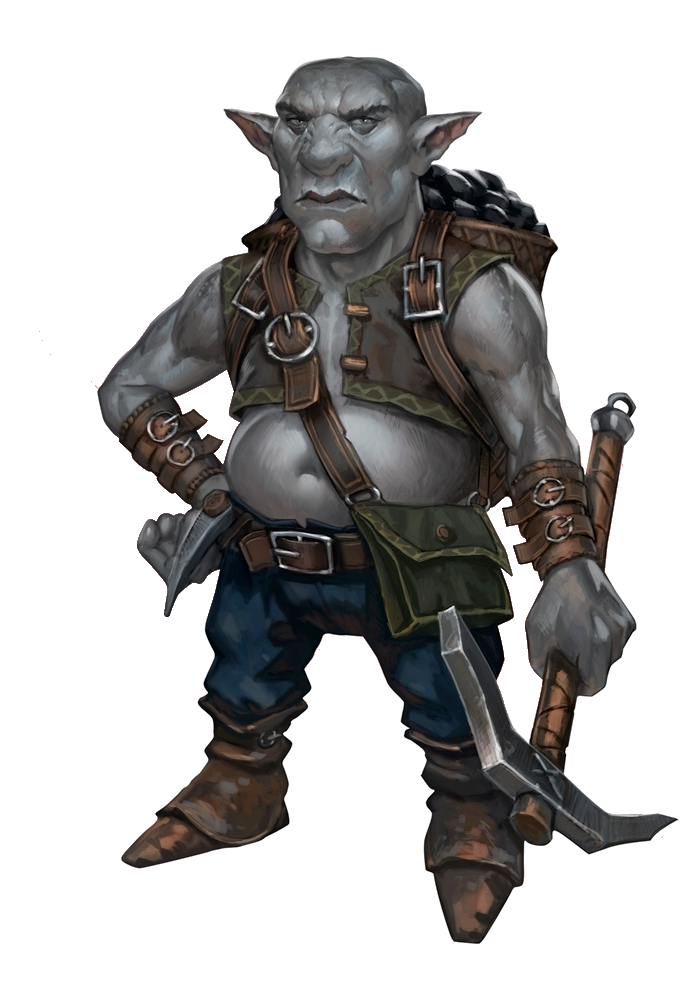
Deep gnomes, or svirfneblin, are the pragmatic and often grumpy cousins of the gnome family, who live deep underground. The Underdark is full of danger, meaning that deep gnomes spend much of their time simply staying alive. They endure this life because the Underdark also holds incredible treasures: minerals and gemstones, gold, silver, and platinum. The svirfneblin mine these materials whenever they find a new deposit.
The svirfneblin do take pleasure from success in these mining operations. A thin smile emerges from the stonelike features of a deep gnome who finds a truly remarkable gem, and such a discovery lightens the mood in the enclave for a time.
Deep gnomes do their best to remain hidden. Even if surface travelers succeed in locating a svirfneblin community, winning their trust can be even more difficult. Those rare travelers who do succeed in befriending deep gnomes find that they are loyal and courageous allies against any foe.
Master Miners
Despite their guarded natures, svirfneblin aren’t joyless. They admire skillful work and delicate craftsmanship, just like any other gnome. Svirfneblin love gemstones of all kinds, and they boldly seek out precious stones in the deepest and darkest tunnels. They are also expert gemcutters and miners, and they prize rubies above all other gemstones.
Hidden but homey
Svirfneblin are known as deep gnomes because they choose to live far below the earth’s surface. Most svirfneblin never see the light of day. Their homes are well-hidden strongholds concealed by mazelike passages and clever illusions. Vast networks of mine tunnels ring most svirfneblin settlements, guarded by deadly traps and concealed sentries.
Everything is designed to make the entrance to a settlement uninviting. But inside its borders, a deep gnome settlement is a warren shaped and decorated by the svirfneblin to make the place welcoming and comfortable.
Although they are skilled stonemasons, svirfneblin appreciate the beauty of natural stone and prefer either to carve to accentuate its features or to leave it unchanged. Their architecture is marked by smooth, curving shapes rather than straight lines and hard edges.
Svirfneblin are intensely community-minded and have little concern about privacy among themselves. Thus, they don’t close off living spaces with doors or window coverings. Most of their homes are sparsely furnished dwellings of one or two rooms. Bed spaces, often carved into the cavern walls, are strung with hammocks for each inhabitant, but often are otherwise empty except for stone coffers holding a few personal effects.
Scouts and Spies
Surface-dwelling gnomes often take up the adventurer’s life out of sheer curiosity about the world around them, eager to see new things and meet new people. By comparison, most svirfneblin possess very little wanderlust and rarely travel far from home. They see the surface world as a bewildering place without boundaries and filled with unknown dangers.
Nevertheless, a few svirfneblin understand that it is necessary to know something about what is happening on the surface near their hidden refuges. As a result, some svirfneblin become scouts, spies, or messengers who venture abroad, doing their best to avoid attention. These travelers are notoriously close-mouthed about where they come from and what they are up to, but a few eventually learn to trust good-hearted people of the surface world.
A few svirfneblin become merchants who deal with other races both above and below ground. Drow, duergar, and other peoples know that svirfneblin are usually neutral in outlook and typically honest in their dealings. Serving as middlemen between races too hostile to deal with each other directly can be lucrative, and it serves an important defensive function; svirfneblin middlemen tend to know more about rumors and threats between rival merchants than anybody else.
Gnome Gods
“Who forged the chains that bind Tiamat in Avernus? Why do the modrons go on the Great March? Who is the Lady of Pain, really? I can’t tell you. but the answers lie in the Colden Hills. And if Carl and his gang don’t know, it can’t be known.”
– Griballix, gnome of Sigil
It shouldn’t be surprising that gnomes, inveterate inventors that they are, have an incredible number of legends they tell about their deities. Every warren has its unique repertoire of tales - some of them no doubt grounded in fact, while others could be the products of imagination. The distinction isn’t important to the folk who take inspiration and pride from the stories of their gods, because each legend is true in its own way.
Each deity in the gnome pantheon is an expert in multiple fields of activity who is capable of incredible feats. Yet these heroes also display shortcomings, such as hesitance or selfishness. Only the chief gnome deity, Garl Glittergold, can convince the others to set aside personal concerns to embark on a grand excursion or to work together toward a common goal. And according to the gnomes, it is proven that their gods can accomplish the impossible when they band together.
Perhaps because of each community’s particular outlook or because the gods frequently use illusory guises, several diverse ideas exist about the membership of the pantheon. In some communities, the gods are thought to be all male or all female; in some they are animals, or constructs made by Garl Glittergold. Some gnomes say Garl has five allies, while others tally eleven.
A consensus of sorts emerges from the totality of these beliefs. Most gnomes believe that Garl Glittergold and his seven able assistants dwell on, in, or under seven summits known as the Golden Hills. This is the place from where new gnomish souls are sent out to experience the wider world, and to which they return to join the hallowed community of those who have come before them. Urdlen is the only gnome deity that doesn’t dwell there, having been exiled by Garl for its refusal to cooperate with the rest of the group.
The Gnome Deities table lists the members of the gnome pantheon. For each god, the table notes alignment, province (the god’s main areas of interest and responsibility), suggested domains for clerics who serve the god, and a common symbol of the god. Several of the gods in the table are described below.
-
Gnomish Deities
Deity Alignment Province Domains Common Symbol Gaerdal Ironhand LG Protection Heroism, Protection, War Iron band Garl Glittergold LG Primary god of gnomes Fortune, Illusion, Trickery, Whimsy Gold nugget Baervan Wildwanderer NG Woodlands Nature Face of a raccoon Baravar Cloakshadow NG Illusion, deception Arcana, Illusion, Trickery Dagger against a hooded cloak Flandal Steelskin NG Metalwork Fire, Forge, Knowledge Flaming hammer Segojan Earthcaller NG Earth, the dead Life, Light, Repose Glowing gemstone Nebelun CG Invention, luck Fortune, Knowledge, Trickery, Whimsy Bellows and lizard tail Sheyanna Flaxenstrand CG Love, beauty, passion Celebration, Charm, Life, Light Two silver goblets Rill Cleverthrush LN Law, thought Fate, Knowledge Interlocking gears Bleredd N Labor, craft Fire, Forge Iron mule Callarduran Smoothhands N Mining, stone carving Earth, Forge, Knowledge Golden signet ring with sixpointed star Gelf Darkhearth CN Frustration, destruction Chaos, Trickery, Vengeance, Whimsy Broken anvil Urdlen CE Greed, murder Death, War White-clawed mole emerging from ground -
Gaerdal Ironhand, The Shield of the Golden Hills
Gaerdal Ironhand has no use for amusements, and she doesn’t deign to smile at any prank except those of Garl Glittergold. Gaerdal obsesses about defense and vigilance, and she is an expert in fortification, siege tactics, combat, and traps.Instead of bustling about as gnome deities normally do, Gaerdal has a tendency to dig in and hide out, and in many tales Garl finds it difficult to convince her to leave her home to join the others on adventures. Some legends say this reluctance is due in part to an escapade that cost her the loss of her hand. Flandal and Nebelun worked together to replace it with a stronger one made of iron, but her resentment over the mishap lingers.
Gnomes build their homes in hidden and defensible places because Gaerdal teaches them these techniques. Every secret door, spy hole, and intruder alarm in a gnome warren is a tribute to Gaerdal’s principles.
-
Garl Glittergold, The Watchful Protector
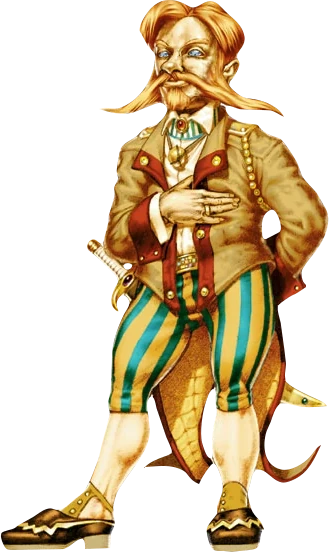 When gnome children hear their first stories about the gods, they are introduced to a gold-skinned gnome with a wide grin and glittering gemstone eyes that shift colors like a kaleidoscope.
The youngsters quickly learn to recognize that their favorite character, the god of the gnomes, is about to steal the show.
When gnome children hear their first stories about the gods, they are introduced to a gold-skinned gnome with a wide grin and glittering gemstone eyes that shift colors like a kaleidoscope.
The youngsters quickly learn to recognize that their favorite character, the god of the gnomes, is about to steal the show.A joker and a prankster, Garl Glittergold reminds gnomes that life is to be taken lightly, and that a good laugh will serve them better than a grim attitude. When Garl cavorts with mischief on his mind, Moradin’s beard might end up woven with giggling flowers, and Gruumsh’s axe could sprout braying donkey heads at the most inopportune time.
Cooperation Is Key. The legends about Garl Glittergold inspire gnomes to work together. Garl knows that many heads and many hands make light work. Although he also plays many pranks on his own, Garl is the one who gathers the heroes together for an enterprise that requires all their talents. To provide specific guidance, Garl might send an omen to nudge a group of gnomes in a certain direction, or even manifest an avatar in the middle of a gnome burrow. When Garl makes one of these rare appearances, it is to resolve a dispute that threatens a community.
Brains over Brawn. Garl favors trickery and illusion over direct combat, preferring to use his mind to overcome a problem rather than his steel. For gnomes to thrive, they must use their intellect and ingenuity. But when push comes to shove, Garl uses Arumdina, his intelligent two-headed battle axe - capable of cleaving through any substance - to escape a perilous situation.
-
Baervan Wildwanderer, The Masked Leaf
Baervan Wildwanderer is the god of the forests and of those who travel, a peaceful soul whose explorations often turn into exciting adventures. Baervan’s constant companion is Chiktikka Fastpaws, a mischievous giant raccoon who often gets the duo into trouble. Although Baervan isn’t as much of a prankster as some of the other gods, she is often held responsible when Chiktikka does something outrageous, such as stealing Gruumsh’s breakfast or peeing on Rillifane Rallathil’s shoes.Baervan can sing every bird’s song, knows every type of plant that has ever grown, never gets lost, and can befriend anyone under the sun (as long as Chiktikka chooses to act pleasant rather than annoying). Forest gnomes believe that they can speak to the animals of the woods and in the air because Baervan teaches their souls how to do so before they are born.
-
Baravar Cloakshadow, The Sly One
When gnomes arrived in the world, Baravar protected them by teaching them how to hide, use magic, and deceive their foes. She was once entrapped by the goblin god Khurgorbaeyag, and after escaping and gaining her revenge, she began the practice of never wearing the same face twice, and she follows a different routine everyday so no one can predict what she might do. Whengnomes tell stories of their gods’ adventures, Baravar is always the last to be found when the group forms, but she nevertheless swiftly agrees to support Garl’s plans.Forest gnomes and deep gnomes owe their innate magical abilities to Baravar, and all gnomes get their natural defense against magic from her shrewdness.
-
Flandal Steelskin, Master of Metal
The stories that gnomes tell of Flandal Steelskin typically feature some perfect item that he crafted or a misadventure that results from following his enormous nose, which can smell ore more easily than a wolf can smell a skunk. The most often told legend of Flandal includes both elements. Before creating Garl’s marvelous axe, Arumdina, Flandal sniffed out the purest source of mithral: the heart of Imix. With the aid of the other gnome gods, he stole the heart and turned it into a mithral forge that now burns with an eternal furious flame.The legends of Flandal portray him not only as the god of metalcraft, but also of fire, glasswork and alchemy. Rock gnomes attribute their knack for crafting devices and alchemical objects to Flandal’s superlative skills in those areas.
-
Segojan Earthcaller, Earthfriend
The gnomes know Segojan Earthcaller as a kind, modest hero. He is said to be the best cook among the gnome gods and to have the power to heal any sickness, because he knows the medicinal and culinary uses of every creature and plant that lives underground. During the misadventures of the gnome pantheon, Segojan contributes to the group through his healing abilities and the restorative power of his meals, and on many occasions the other gnome gods call upon him to use his ability to burrow through any substance.Forest gnomes believe that their ability to speak with burrowing animals comes from Segojan. All gnomes see Segojan as a healer of the sick and a protector of the hearth. He is also revered in his role as a guide for gnomish souls after death, as long as the body is buried before worms claim it. If a gnome’s body isn’t entrusted to Segojan by interring it, the soul is forced to find its own way to the afterlife.
-
Nebelun, The Meddler
Nebelun is fearless, perhaps foolishly so. Every invention of Nebelun’s startswith a wild idea, nothing goes entirely according to plan, and her greatest exploits often spring from mistakes. Who else would stroll in and steal Semuanya’s tail as the lizard folk god splashed in his favorite pool? Who else would use Thor’s hammer to pound a nail and thus be inspired to invent the lightning rod? Gari never needs to persuade Nebelun to join an excursion, but he and the rest of the pantheon do have to focus her attention on the task at hand, so that her madcap inventiveness doesn’t derail the effort.All gnomes see Nebelun as the delightful spirit of invention and discovery, even those whose livelihoods have nothing to do with the construction of odd devices. Any accident that fortuitously results in a new discovery might be credited to Nebelun’s benevolent meddling in the affairs of mortal gnomes.
-
Callarduran Smoothhands, The Deep Brother
Callarduran became the patron of the deep gnomes when he led them into the Underdark and taught them how to survive, but all gnomes see him as the embodiment of the drive to know more, to examine everything more minutely - and thereby make great discoveries.Callarduran earned his moniker when, after stealing the heart of Ogremoch, he rubbed his hands smooth as he polished the heart and turned it into a magical stone. The theft caused Ogremoch to turn to evil, but it gave Callarduran the power to control earth elementals - which, it is said, he can confer to deep gnomes by rubbing the stone and saying their names.
-
Urdlen, The Crawler Below
Many pantheons include in their number a miscreant or an outlier - someone not to be emulated in the customary way, and often an entity whose existence serves as an object lesson and an example of what befalls mortals who conduct themselves the same way. For the gnomes, this niche is filled by Urdlen, also known as the Glutton for its selfish and cruel behavior.Though the details differ from telling to telling, all gnomes know the story of how Garl banished Urdlen from the Golden Hills because Urdlen refused to go on an important quest. Despite Garl’s efforts and the pleas of the rest of the pantheon, Urdlen selfishly refused to set his own interests aside and contribute to the group.
Every version of this story ends in some sort of tragedy - perhaps the loss of Gaerdal’s hand, the affliction that caused Flandal to need new skin, or the disappearance of Baravar’s shadow - and each one concludes with “And that is why Garl sent Urdlen into exile.” In tales of his later life, Urdlen is no longer a gnome but has become a greedy and destructive monster, a great blind and hairless mole with iron claws and teeth.
Gnomes believe that Urdlen exerts influence on their lives when they experience jealousy, greed, petulance, or envy. Individuals are more likely to fall prey to these feelings when they don’t spend enough time in activities with others, and so tales of Urdlen serve as a somber reminder of the importance of participating in society.
Gnome Adventurers
“I don’t know how many times I’ve seen a gnome turn a dead end into a wonderful opportunity.”
– Delaan Winterhound

When a gnome leaves the burrow, the force behind that decision is almost always curiosity -an insatiable need to seek out and experience what the world has to offer.
Sometimes the adventuring life is the natural outgrowth of a gnome’s research project or experiment. A rock gnome alchemist who discovers a new form of fungus growing in a nearby cavern might wander farther afield from the burrow, looking for knowledge about other fungi in the world. A forest gnome who hears about a master illusionist in a faraway realm could embark on a journey to find that person and learn new tricks. A rock gnome artificer might become determined to locate any deposits of a rare metal, willing to travel the world high and low in search of it. Even a deep gnome might be born with an irrepressible urge to leave the Underdark and join a group to pursue a life of shared purpose.
Some gnome communities make a practice of sending young adults away from the burrow as a rite of passage, encouraging them to explore the realms of humans, dwarves, and elves for a time, with instructions to bring back information and new ideas for the community.
Most of these folk return to the burrow at the appointed time or even sooner, their curiosity having been satisfied. But a few of them take readily to life in the outside world and don’t come back on schedule, returning to the burrow only after spending years or decades away as a member of an adventuring party.
The pull of the stars
Because of their extensive travels, gnome adventurers often become fascinated with the grandeur of the cosmos as seen in the motion of the stars across the sky. They view the cosmic array as a giant machine of wonderful complexity -a banquet for a curious gnomish mind. Many renowned astronomers, wizards, and extraplanar travelers are gnomes, having undertaken those disciplines in the hope of better understanding the workings of the multiverse.
A gnome’s role
Gnomes are valuable members of an adventuring party for a number of reasons, derived from both their innate abilities and their unique mind-set.
Possessed of higher intelligence than most other races, a gnome can be an important source of knowledge, and can devise solutions for many problems an adventuring party encounters. A rock gnome rogue on a dungeon expedition, if not lost in thought, can steer a party clear of many obstacles. Even the most complex magical or mechanical traps can be disarmed by a rock gnome who takes pride in solving difficult puzzles.
A forest gnome’s skills are invaluable in the wilderness. Forest gnomes can spot subtle tracks, uncover clues that others would miss, and locate the safest path. Their illusion magic taunts, deludes, and terrifies enemies at the same time it delights their friends.
Forest gnomes and rock gnomes also contribute to a party by being a source of optimism and levity. Even in the worst circumstances, a gnome can find something to be hopeful for -an attitude that is infectious and thus can keep the group from falling into despair.
A deep gnome, pragmatic and cautious, brings a sense of duty rather than a sense of humor to an adventuring group. With their grit and iron will, deep gnomes meet adversity with hammers, picks, and their dour, dry wit -or no wit at all- as their weapons of choice.